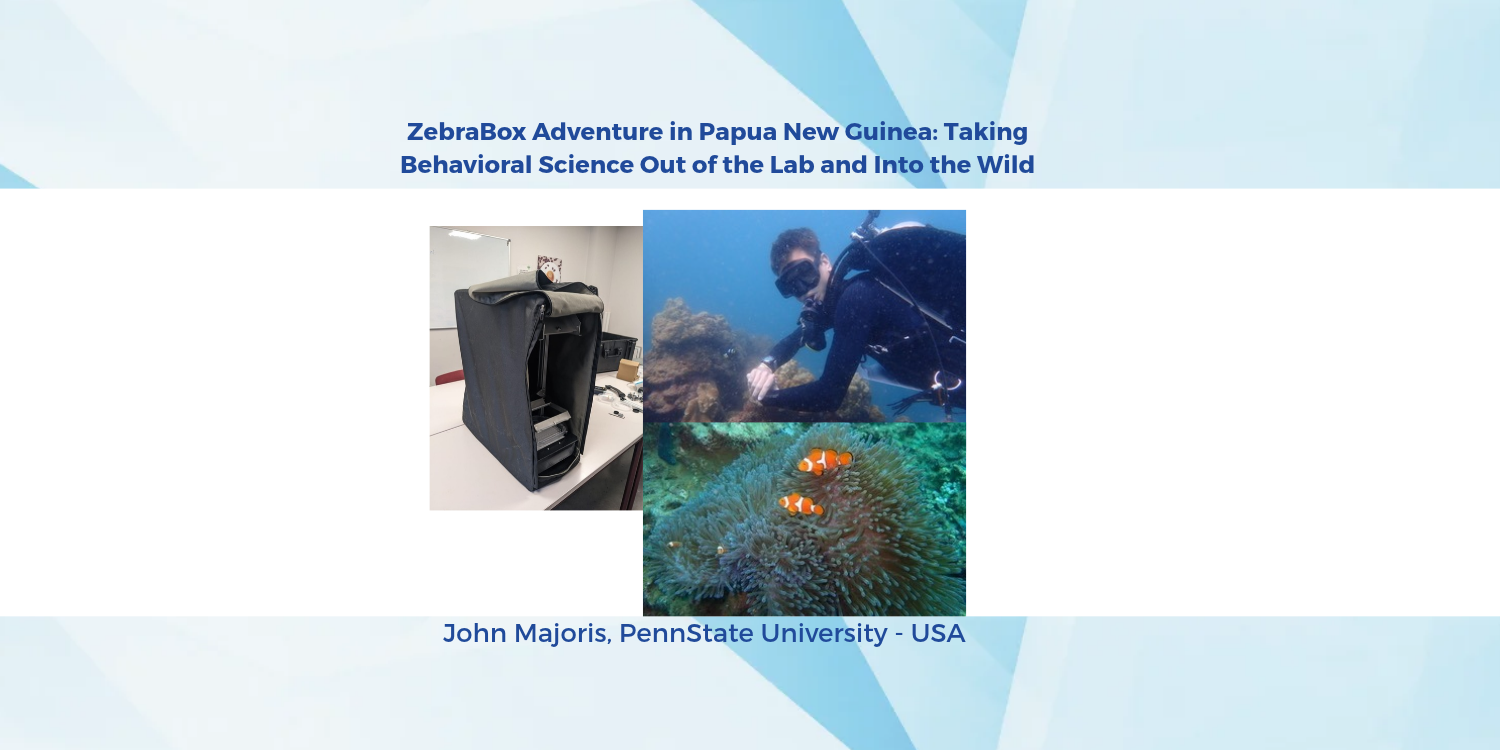


For a piece of high precision behavioral research equipment, this is an unusual place to be
In fact, there's nothing unusual about science taking place outside the controlled environment of a research lab. Sometimes, the questions we ask can only be answered in the wild - whether it's a coral reef thousands of kilometers away from the nearest university, or in the depths of the ocean.
This is the story of a collaboration between ViewPoint and Dr. John Majoris of Penn State, and how a ZebraBox was re-engineered to take a trip as checked luggage while running in the field in Papua New Guinea.
Why larvae matter ?
John's research looks at variation in early life-history traits and how that variation influences dispersal and population structure, in coral reef fishes. Specifically, the dispersal (and attendant processes such as recruitment and population connectivity) of reef fishes during their larval stage. This is a critical period of a fish's life and John's work, alongside his colleagues', looks at the factors which influence larval survival as well as orientation and swimming behaviors. Traditionally, it was thought that larvae had little control of where they swam - they were primarily transported via ocean currents. However, Dr. Majoris and his peers have contributed significantly to our understanding of this process, demonstrating that larvae are in fact active swimmers with complex sensory and orientation capabilities, which have a direct effect on the spatial scale of connectivity.
The importance of understanding these processes is manifold - the dispersal of larvae has implications for how isolated reef systems are from one another, the replenishment of marine protected areas, and the overall stability of the ecosystem. In turn, understanding the biological basis of larval behavior can inform management options to aid in conservation. John's work fits into a larger context of his professional interests in marine ecology, animal behavior, sensory biology, and aquaculture. He is especially interested in the ways that animals interact with and adapt to their environment.
The challenge: going on the road
In order to study the behaviors of these larvae, Dr. Majoris and his team have to conduct observations which take place in-situ, in the wild. In particular, they traveled to Papua New Guinea to observe clownfish and butterflyfish populations in the region, specifically looking at the dispersal characteristics of their larvae. However, there was a problem with the equipment. Traditional behavioral observation equipment is not designed to be transported to remote locales as checked luggage. There were a number of additional constraints which the team had to take into account - including the fact that the local field station was thousands of kilometers away from the nearest university. The instrument they needed had to be able to:
• Function as checked luggage while also being field-ready
• Survive the rigors of transportation
• Be simple to set up and use in a remote field environment
A standard ZebraBox isn't built for this type of endurance or versatility - that's where ViewPoint came in.
The solution: a field-ready ZebraBox
ViewPoint worked closely with Dr. Majoris's team to develop a customized ZebraBox ideal for use in the remote field. We started with the chassis itself and worked on reducing weight and size in order to meet the size requirements of commercial airlines. Every component was scrutinized with an eye towards transportation and making the system more field-friendly. Next, we developed purpose-designed protective packaging to meet the needs of the user while also protecting the ZebraBox during transport. The result was an instrument which could meet the needs of a remote field station while also being simple and intuitive to use, once unpacked.


What this means for John's research
Ultimately this means the ability to perform the exacting standards of ZebraBox behavioral analysis in one of the most remote locales on the planet. For Dr. Majoris, a field-ready ZebraBox means addressing questions which have traditionally been asked in the confines of a laboratory. The system is ideally suited towards his research goals - studying the behavioral sequences of reef fish larvae in their developmental habitats. The orientation behaviors of these larvae are of specific interest to Dr. Majoris, as are the variations of these behaviors throughout development and the effects they have on overall dispersal. The ability to conduct these observations out in the field has a number of benefits to both the team and to the study, as it allows them to study the animals in their natural environment while also overcoming the limitations of traditional observation equipment in a remote setting.
For us at ViewPoint, this is an opportunity to work with a client who shares our passion for innovation and discovery. We believe strongly in supporting the scientific process, and in creating tools which enable groundbreaking work to be done outside the walls of an academic institution. For Dr. Majoris, the field-ready ZebraBox is a tool which makes it possible to conduct truly revolutionary scientific studies. The ability to observe larvae in the wild is paramount to his research into larval orientation behaviors and their effect on broader processes of population genetics and dispersal. And so the ZebraBox made quite the journey to get to Papua New Guinea - one which we hope will contribute to a lifetime of discoveries in the natural world.
Thank you to John Majoris for these magnificent photos and for giving ViewPoint the opportunity to demonstrate once again its ability to adapt to requests that are sometimes rather out of the ordinary.