Decoding the Dance of Light and Neurons: The Science Behind the Study
We would like to extend our warmest congratulations to the brilliant international team whose collaborative efforts made this breakthrough possible.
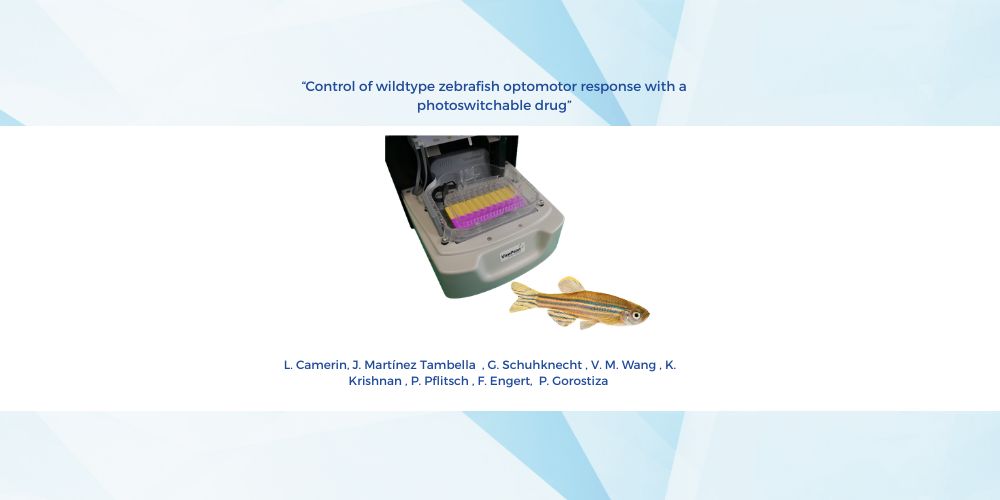
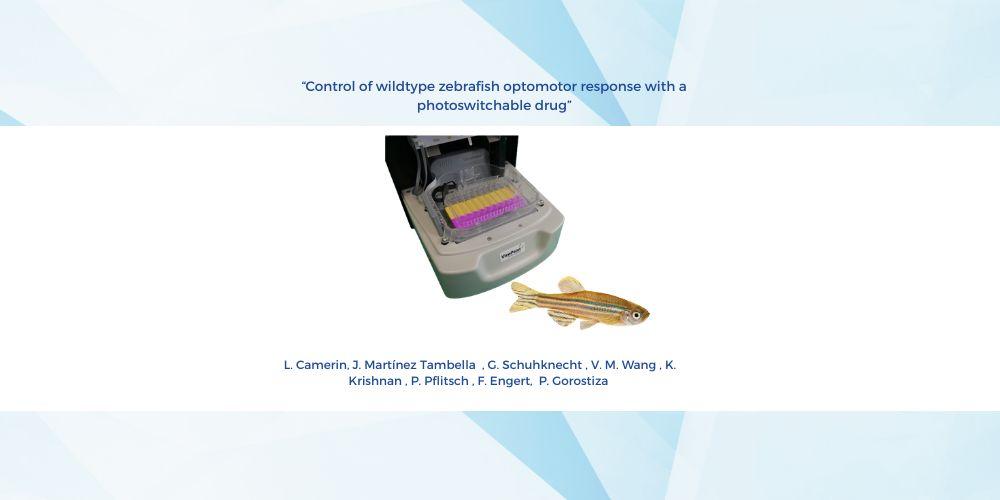
Researchers from Spain, USA and Germany, recently published a groundbreaking study titled "Control of wildtype zebrafish optomotor response with a photoswitchable drug," which explores how scientists can manipulate behavior without genetic modification. Traditionally, neuroscientists rely on optogenetics to control neural circuits using light. However, this approach requires inserting foreign genes into an animal’s DNA. Consequently, the scientific community has turned to photopharmacology as a powerful alternative. By using light-sensitive drugs that activate or deactivate upon exposure to specific wavelengths, researchers achieve precise circuit perturbation in completely wildtype animals. This method opens new doors for studying complex neural pathways in their natural state.
The publication specifically targets the optomotor response (OMR), a fundamental sensorimotor behavior where zebrafish larvae swim in the direction of moving visual patterns. Scientists use this reflex to assess visual processing and motor coordination. Through targeted photostimulation, the research team demonstrated that they could toggle this reflex on and off simply by changing the wavelength of light hitting the photoswitchable drug. Therefore, this work represents a massive leap forward in non-invasive neuromodulation, proving that researchers can dissect brain function dynamically while keeping the organism's genome entirely intact.
A Step-by-Step Blueprint: The Protocol Driving the Discovery
To replicate these remarkable findings, the researchers developed a rigorous protocol that ensures high reproducibility across different laboratories. First, they incubate wildtype zebrafish larvae in a solution containing the photoswitchable compound, allowing the drug to permeate the tissues and reach the central nervous system. Next, they transfer the treated larvae into specialized multi-well plates filled with fresh water. Following this preparation step, the team places the plates inside a controlled behavioral tracking arena. They then deliver alternating wavelengths of light—typically ultraviolet to activate the drug and visible blue or green light to deactivate it—while simultaneously presenting moving visual gratings to trigger the OMR.
During the experiment, automated software tracks every movement the larvae make, quantifying their swimming speed, distance traveled, and directional alignment with the visual stimulus. Because the protocol avoids physical restraints, it preserves the natural expression of sensorimotor behavior. Furthermore, the researchers include strict control groups, such as untreated larvae exposed to the same light conditions, to confirm that the observed effects stem directly from the drug rather than the light itself. Ultimately, this streamlined methodology allows scientists to perform rapid, reversible circuit perturbation experiments, establishing a gold standard for future studies in behavioral neuroscience.
The Technological Backbone: Harnessing the ZebraBox and Its Powerful Add-Ons
Executing this sophisticated protocol demands highly reliable hardware, and the researchers actively chose the ZebraBox developed by ViewPoint Behavior Technology to anchor their experimental setup. The ZebraBox serves as a comprehensive, enclosed arena that eliminates external light contamination and acoustic disturbances, ensuring pristine data collection. Inside this chamber, integrated cameras capture high-resolution video of the larvae, while built-in LED panels deliver the precise visual stimuli required to elicit the optomotor response (OMR). Moreover, the system seamlessly synchronizes the delivery of pharmacological photostimulation with the presentation of moving gratings, providing researchers with total environmental control over the experiment.

Beyond the core tracking capabilities, the study highlights the critical role of specific ZebraBox add-ons, particularly the place preference screen. Researchers utilize this screen module to conduct conditioned place preference assays alongside OMR testing. By dividing the well into distinct zones illuminated by different colors or patterns, the place preference screen allows scientists to evaluate whether the photoswitchable drug alters spatial memory, anxiety-like states, or general exploratory drive. These add-ons transform the ZebraBox from a simple tracking device into a multifaceted behavioral laboratory. As a result, investigators can correlate changes in basic reflexes with higher-order cognitive shifts, painting a complete picture of how targeted neuromodulation influences the entire behavioral repertoire of the zebrafish.
In conclusion, this publication brilliantly merges chemistry, optics, and advanced behavioral tracking. By combining the precision of photopharmacology with the robust engineering of the ZebraBox and its versatile add-ons like the place preference screen, researchers now possess an unparalleled toolkit. They can explore the depths of the vertebrate brain without altering a single gene, pushing the boundaries of what we understand about neural circuits and behavior.
Link to the scientific publication : https://www.biorxiv.org/content/10.64898/2026.03.05.709743v1.full.pdf