Why Maze Complexity Matters: Using Mazes to Boost Cognitive Capabilities in Rodents
An evidence-based look at how spatial enrichment supports hippocampal neurogenesis in rats and mice — and what a recent comparative study tells us about designing better enrichment strategies.
The brain responds to the environment
One of the most robust findings in modern neuroscience is that the brain remains structurally plastic throughout life. In rodents, and in humans too, the hippocampus continues to produce new neurons well into adulthood, a process known as adult hippocampal neurogenesis. This process is not fixed: it is powerfully stimulated by the environment, and in particular by spatial complexity.
Among the many forms of environmental enrichment available to laboratory rodents , tunnels, toys, nesting material, running wheels, mazes occupy a unique position. Their structured pathways, choice points and navigation demands engage spatial learning and memory circuits directly, making them one of the most functionally relevant ways to challenge the rodent brain.
What does the science say ?
A recent original research article published in Frontiers in Neuroscience, "Comparative analysis of maze complexity: implications for adult hippocampal neurogenesis" by Mohamed Hesham Khalil (Department of Architecture, University of Cambridge), provides a quantitative framework for this question.
Using a novel metric called the Architectural Spatial Complexity Index (A-SCI), the author compared the spatial complexity of 16 rodent maze configurations — including mazes previously shown to stimulate neurogenesis. The analysis confirmed that the tool clearly differentiates enriched housing from standard cages, and revealed substantial variation in complexity across maze architectures, from simple T-mazes to elaborate multi-pathway structures.
Why does this matter?
Because quantifying complexity is the first step towards standardizing enrichment — moving from "more stuff is better" towards an evidence-based design of housing that maximizes pro-neurogenic stimulation while remaining comparable across studies :
- Mazes are legitimate enrichment. The analysis found no significant difference in overall complexity between maze-based enrichment and object-based enrichment — supporting earlier landmark experiments showing that complex mazes produced cortical growth almost identical to that obtained with enriched object conditions.
- Complexity can now be measured, not just assumed. The A-SCI gives researchers a way to compare and report the spatial complexity of their housing setups, improving reproducibility.
- Translation to humans. Because navigating complex environments is associated with preserved hippocampal volume and lower Alzheimer's risk in humans, maze-based paradigms offer a promising bridge between rodent research and human cognitive health.
The Marlau™ cage: enrichment that combines complexity and novelty
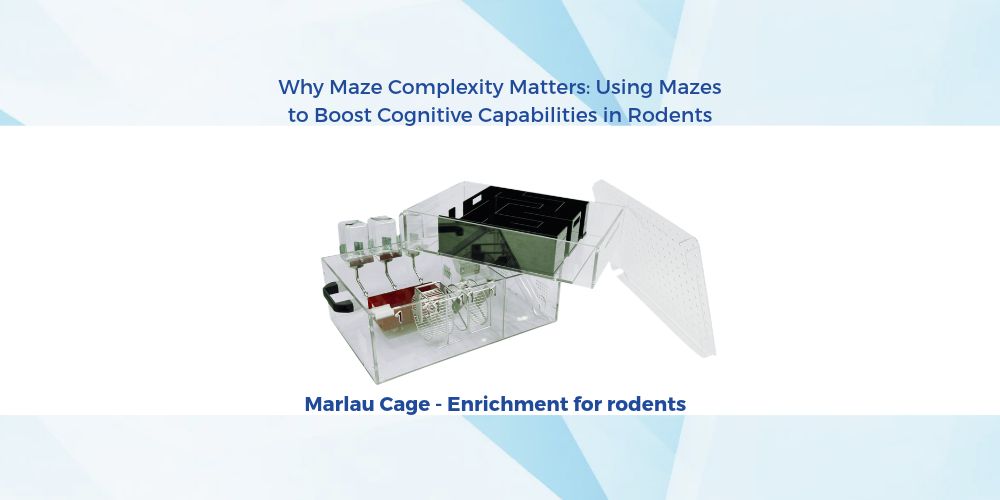
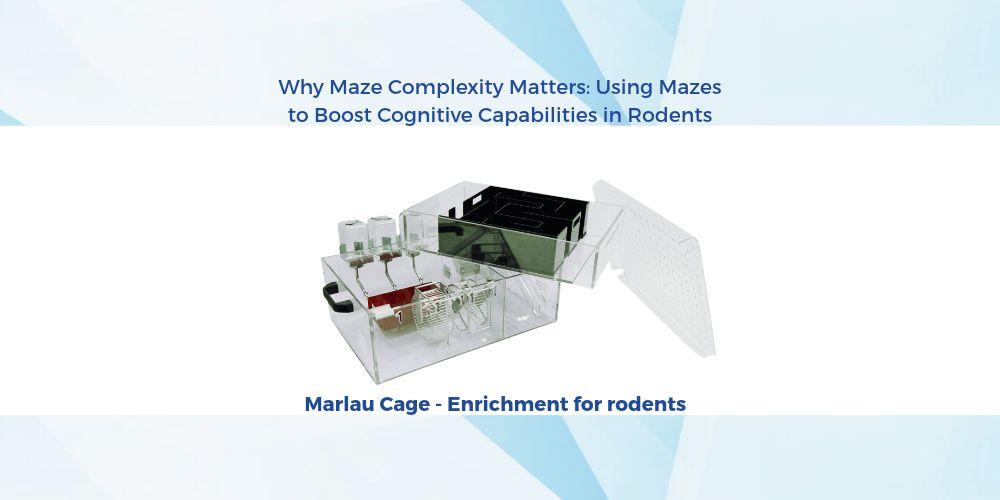
Among the maze-based enrichment solutions discussed in the literature, the Marlau cage stands out as a particularly well-designed example — and it is one of the configurations analyzed in Khalil's comparative study.
The Marlau cage was specifically conceived to combine several pro-neurogenic ingredients in a single housing system :
- A maze that changes. The maze configuration separating the food and water compartments is regularly modified — in the studies cited, three times per week. This rotation introduces sustained novelty, preventing the habituation that progressively reduces the benefit of static enrichment.
- Cognitive engagement, not just activity. To access food and water, animals must actively explore and solve the maze, engaging spatial navigation and memory on a daily basis — exactly the type of cognitive stimulation linked to hippocampal plasticity.
- Voluntary exercise built in. Running wheels are integrated, supporting the known neurogenic effect of voluntary exercise, alongside large exploration surfaces.
- A standardized protocol. Because the enrichment is delivered in the home cage rather than in a separate test apparatus, all animals receive comparable stimulation — reducing inter-individual variability that complicates group housing studies.
This combination of complexity, novelty and exercise is what makes maze-based housing like the Marlau cage scientifically distinctive: published data show that rats housed in the Marlau cage displayed increased hippocampal neurogenesis, with a greater number of newborn cells in the dentate gyrus, the majority differentiating into mature neurons.
Why this matters for your research ?
For laboratories studying neurodegenerative diseases, depression, chronic stress, aging or cognitive enhancement, the quality of environmental enrichment directly influences both animal welfare and scientific outcomes. A well-designed maze-based enrichment strategy can:
- Enhance adult hippocampal neurogenesis and spatial memory performance,
- Provide more cognitively "normal" control animals,
- Reduce stereotypic behaviors and improve welfare,
- Improve the translational relevance of rodent models of human cognition.
As research moves towards quantifying what "complexity" actually means — as illustrated by Khalil's A-SCI framework — tools like the Marlau cage provide a concrete, validated way to put these principles into practice in everyday housing.
Further reading
- Khalil MH (2026). Comparative analysis of maze complexity: implications for adult hippocampal neurogenesis. Frontiers in Neuroscience —
read the full article